


SHOCK • VENTILATION • CARDIAC ICU • SEPSIS • NEURO • HEME-ONC • METABOLIC EMERGENCIES
Critical Illness Does Not
Always Begin in the ICU.
Hospitalists, emergency physicians, internists and surgical teams
frequently encounter patients with hemodynamic instability,
respiratory deterioration, sepsis, cardiac emergencies and
multi-organ dysfunction before or outside traditional intensive care settings.
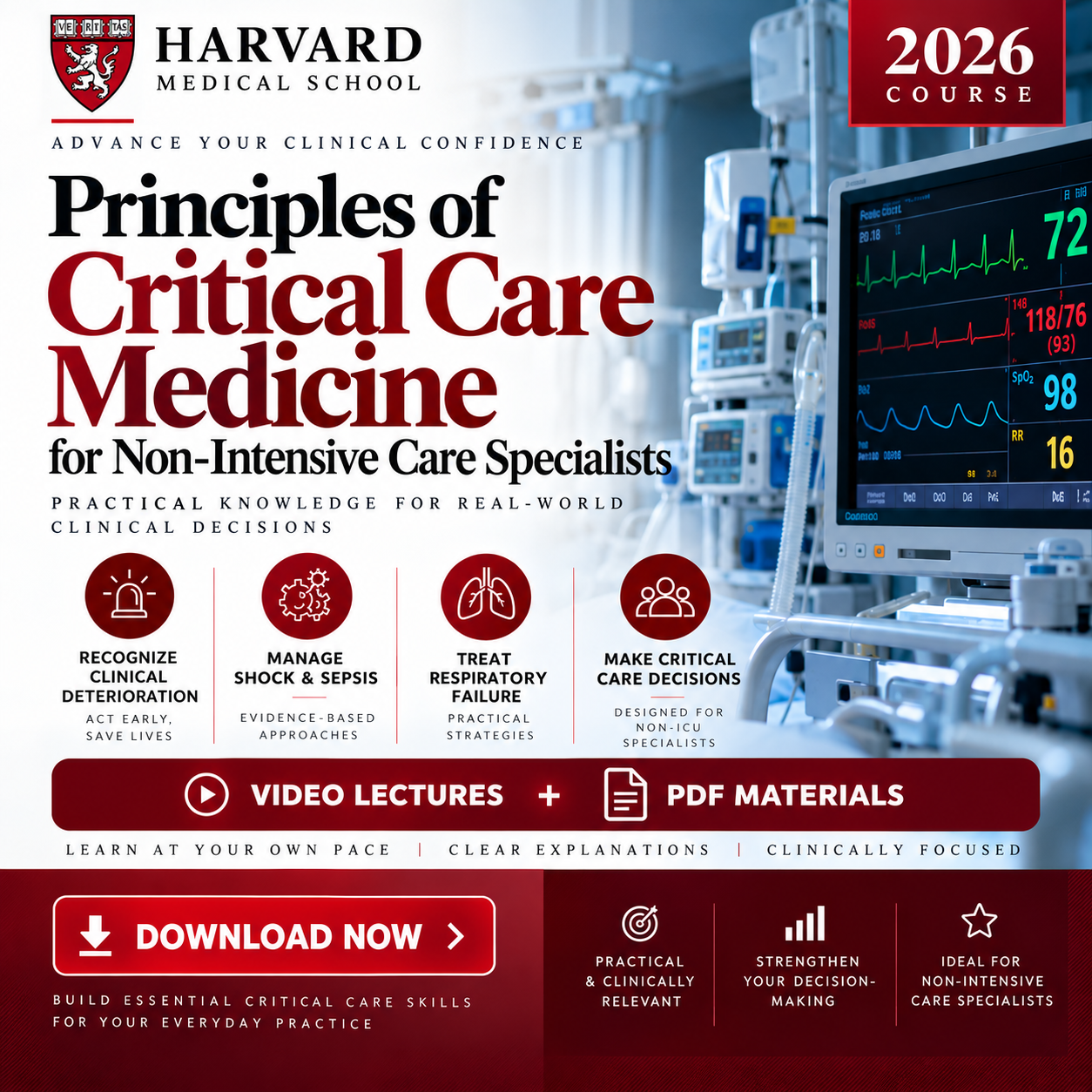
Harvard Principles of Critical Care Medicine for Non-Intensive Care Specialists 2026
provides a practical review of critical care principles with emphasis on
clinical reasoning, bedside assessment, evidence-based treatment and
multidisciplinary management of critically ill patients.
The curriculum combines expert-led lectures, case-based discussions,
rapid clinical refreshers and focused clinical questions across the
major domains of modern critical care medicine.
Preview the Critical Care Program
Watch the available course demo for a closer look at the educational
content and teaching format before exploring the full curriculum.
Critical Care Medicine 2026 Preview
Click to watch the available course demo
A Practical Framework
for the Unstable Patient
The curriculum helps clinicians organize critical care decisions
from initial recognition through stabilization and escalation of care.
Identify the Immediate Threat
Recognize shock, respiratory deterioration, cardiac emergencies,
neurological changes and other signs of critical illness.
Support Airway, Breathing & Circulation
Apply practical principles of resuscitation, vasopressor therapy,
respiratory support and emergency management.
Understand the Physiology
Use bedside assessment, laboratory data, ECG, ultrasound
and hemodynamic information to clarify the clinical problem.
Manage Organ Dysfunction
Review ventilation, cardiovascular support, metabolic management,
sedation and other critical care interventions.
Coordinate the Next Level of Care
Recognize when patients require advanced critical care interventions,
specialty support or transfer.
The Pressure Is Low.
What Happens Next?
The opening critical care curriculum focuses on practical approaches
to shock physiology, resuscitation, vasoactive therapy and bedside
assessment of volume responsiveness.
From the ABG
to the Ventilator.
The pulmonary curriculum moves from fundamental blood gas interpretation
to invasive and non-invasive respiratory support, ventilator management,
weaning and selected advanced respiratory therapies.
The ABCs of ABGs
Rapid review of arterial blood gas interpretation.
Vents 101 → Vents 102
Build from foundational ventilator principles toward more advanced management.
HFNC & Non-Invasive Ventilation
Review modern respiratory support devices and NIV principles.
Spontaneous Breathing Trials
Understand settings and considerations for assessing readiness to liberate from ventilation.
Difficult-to-Wean Patients & VV ECMO Consideration
Review difficult extubation decisions and when advanced respiratory support may be considered.
When the Cardiovascular System
Becomes the Emergency.
Review major cardiovascular problems encountered in critically ill patients,
from rhythm emergencies and cardiogenic shock to pulmonary embolism,
heart failure and mechanical circulatory support.
10 Critical Care Domains
A broad multidisciplinary curriculum spanning the major clinical problems
encountered in critically ill patients.
Recognize Infection.
Respond to Deterioration.
The infectious disease curriculum reviews sepsis and other high-risk
infectious problems encountered in critically ill patients.
Modern Cancer Therapy
Creates New ICU Emergencies.
The course reviews hematology-oncology emergencies and complications
associated with modern cancer treatments that critical care clinicians
may encounter.
When the Numbers
Become the Emergency.
Critical Problems
Beyond the Medical ICU
When Mental Status Changes,
Find the Cause.
Focused neurological sessions address important acute problems
encountered in critically ill patients.
Beyond Keeping
the Patient Comfortable
Critical Care Is More
Than Organ Support.
The final curriculum expands beyond physiology to communication,
palliative care, survivorship, cognitive errors, quality improvement
and emerging artificial intelligence applications.
Build Practical Confidence
in Critical Care
For Clinicians Who May Be
First to Recognize Deterioration
Relevant to a broad multidisciplinary audience involved
in acute inpatient and critical care.
Study the Complete Program
at Your Own Pace
Recorded Educational Lectures
Critical care medicine, emergency management, ventilation,
hemodynamic monitoring and ICU decision-making.
PDF Educational Materials
Supporting lecture presentations and educational reference documents.
Case-Based Sessions
Practical clinical discussions built around critical care problems.
Rapid Refreshers & Quick Hits
Focused reviews of clinically important critical care concepts.
Critical Care Knowledge
Built for Real Clinical Problems.
The program is structured around the problems clinicians actually
encounter when patients become critically ill, combining comprehensive
coverage with practical clinical questions and focused refreshers.
“`





Reviews
There are no reviews yet.