


“`html
Stroke • Headache • Orbit • Spine Trauma • Pediatric Neuroemergencies
When Time Is Critical,
Every Imaging Finding Matters.
In the acute-care environment, neurological imaging findings may directly
influence urgent clinical decisions. Recognizing subtle abnormalities,
dangerous patterns and critical red flags is therefore an essential component
of emergency neuroradiology.
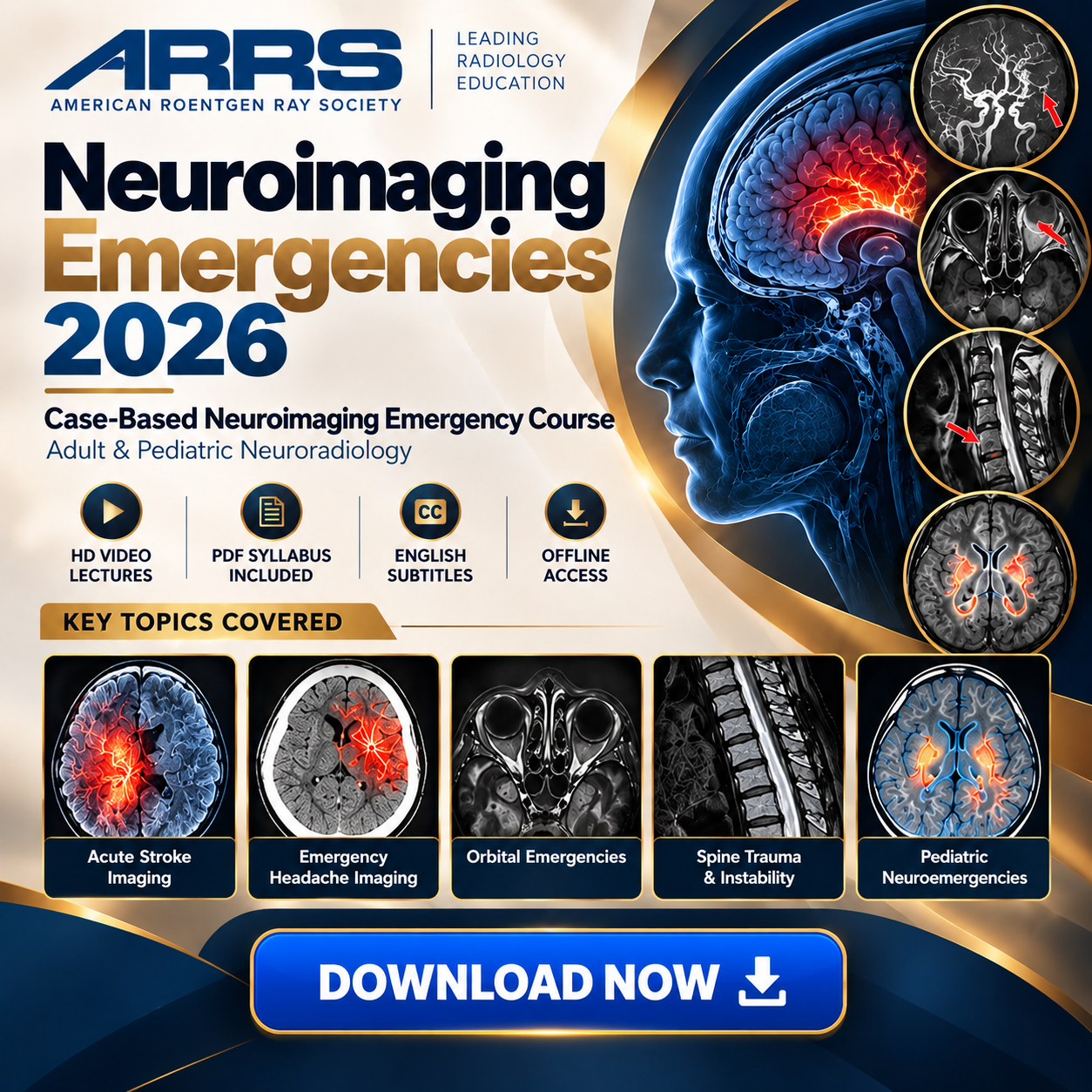
ARRS Neuroimaging Emergencies 2026
provides a focused, case-based review of important neurological imaging
emergencies encountered in both adult and pediatric patients.
The program emphasizes critical imaging findings, differential diagnosis
and systematic approaches designed to strengthen interpretation
in high-pressure emergency situations.
From First Image
to Critical Finding.
A structured emergency imaging mindset helps transform
complex studies into focused diagnostic decisions.
Find the Critical Abnormality
Recognize subtle and overt imaging findings that may represent
an urgent neurological process.
Define the Anatomic Problem
Localize pathology across the brain, orbit,
spinal column and spinal cord.
Build the Differential
Integrate the imaging pattern and clinical context
to develop an appropriate differential diagnosis.
Identify Diagnostic Red Flags
Recognize features requiring additional investigation,
urgent attention or intervention.
Communicate the Critical Finding
Prioritize clinically important abnormalities in the
time-sensitive acute-care imaging environment.
Five High-Stakes Areas
of Neuroimaging
Acute Stroke Imaging
Typical and atypical imaging features of acute stroke,
including findings beyond large vessel occlusion.
Emergency Headache Imaging
A systematic approach to patients presenting with headache,
with emphasis on important abnormalities and imaging red flags.
Orbital Emergencies
Traumatic, infectious and vascular orbital emergencies
and their key imaging appearances.
Spinal Trauma
Critical spinal injuries, ligamentous disruption,
spinal instability and spinal cord injury.
Pediatric Neuroemergencies
Important imaging findings and diagnostic red flags
in pediatric neurological emergencies.
Stroke Imaging
Beyond LVO.
Emergency stroke interpretation requires recognition of more
than large vessel occlusion. The course addresses typical
and atypical imaging features encountered in acute stroke.
Beyond
“No Acute Abnormality.”
Headache is a common emergency presentation, but imaging interpretation
requires awareness of findings that should trigger further investigation.
Trauma Is Only
Part of the Differential.
The orbital emergency curriculum examines both traumatic
and critical non-traumatic conditions.
Recognize imaging features associated with orbital trauma.
Identify important imaging findings associated with infection.
Recognize vascular conditions requiring urgent attention.
Develop an appropriate diagnostic differential
for emergency orbital imaging findings.
Recognize Instability
Before It Is Missed.
Emergency spine imaging requires more than fracture detection.
The course reviews injuries that may indicate mechanical instability
or neurological risk.
The Pediatric Study
Needs a Different Lens.
Pediatric neurological emergencies present distinct imaging
patterns and red flags. The program highlights findings that
should prompt careful evaluation in younger patients.
Identify important abnormalities in pediatric emergency neuroimaging.
Recognize findings requiring further investigation or urgent attention.
Develop a more focused approach to pediatric neurological emergencies.
What You Should Be Better
Prepared to Recognize
Typical and atypical acute stroke imaging features beyond LVO
A systematic approach to emergency headache imaging
Imaging red flags requiring additional investigation or intervention
Traumatic, infectious and vascular orbital emergencies
Appropriate differential diagnoses for orbital emergencies
Critical spinal injury and ligamentous disruption
Imaging patterns of spinal instability and spinal cord injury
Important pediatric neuroimaging red flags
Focused Emergency
Imaging Sessions
Headache in the ER: Beyond No Acute Abnormality
Harprit S. Bedi
A focused approach to emergency headache imaging,
including important abnormalities and diagnostic red flags.
Orbital Emergencies: Trauma and Critical Non-Traumatic Conditions
Parisa Mazaheri
Important traumatic and non-traumatic orbital emergencies,
including infectious and vascular conditions.
Imaging of Spine Trauma
Roy F. Riascos
Critical spinal injuries, ligamentous disruption,
spinal instability and spinal cord injury patterns.
Pediatric Neuroemergencies: Key Red Flags
Anna Baer
Important imaging findings and red flags
in pediatric neurological emergencies.
Emergency Neuroimaging Coverage
Neuroimaging Emergencies
Emergency Neuroradiology
Acute Stroke Imaging
Stroke Beyond LVO
Emergency Headache Imaging
Orbital Trauma
Infectious & Vascular Orbital Emergencies
Spine Trauma & Instability
Spinal Cord Injury
Pediatric Neuroemergencies
For Clinicians Reading
Time-Sensitive Neuroimaging
Particularly relevant for radiology professionals
and clinicians involved in acute neurological care.
ARRS Neuroimaging Emergencies 2026
American Roentgen Ray Society (ARRS)
Radiology / Neuroradiology
Neuroimaging Emergencies
On-Demand Educational Course
Adult & Pediatric
2026
Emergency Imaging Leaves
Little Room for Delay.
The course focuses on practical recognition of imaging abnormalities
that can influence urgent diagnostic and clinical decisions.
Case-based emergency neuroradiology
Adult and pediatric cases
Critical imaging red flags
Practical differential diagnosis
Stroke and emergency headache imaging
Orbital emergencies
Spine trauma and instability
Pediatric neuroemergency recognition
“`










Reviews
There are no reviews yet.