



READ → RECOGNIZE → DIFFERENTIATE → DECIDE
Train Your Eye.
Sharpen Your Differential.
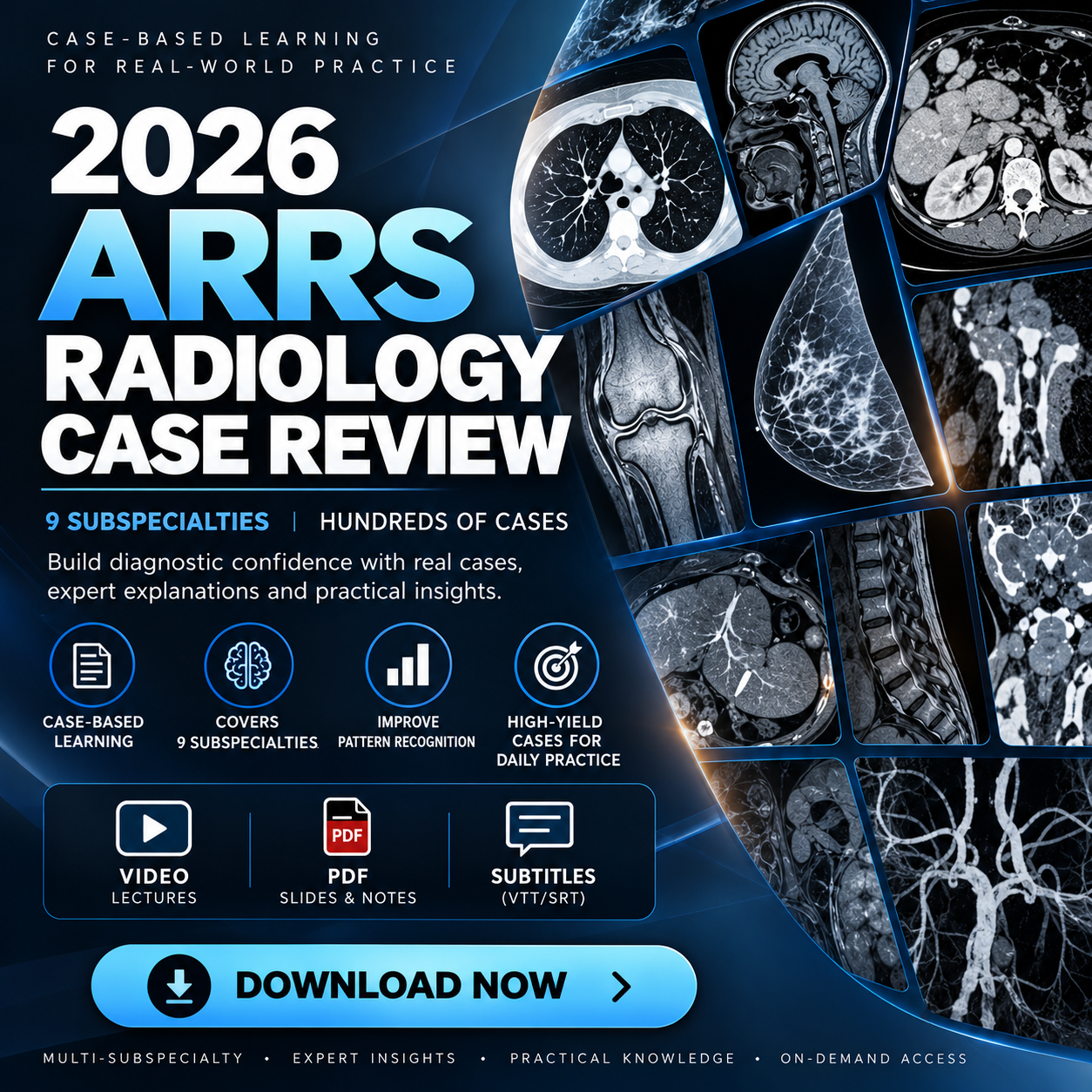
The 2026 ARRS Radiology Case Review
is a comprehensive case-based educational program designed for radiologists
in training and practicing radiologists seeking broad diagnostic review.
Using rapid-fire clinical cases, expert faculty reinforce foundational
knowledge while challenging learners to recognize characteristic imaging
patterns, develop appropriate differential diagnoses and integrate clinical
information into diagnostic reasoning.
The curriculum spans nine modules covering major areas of diagnostic
and interventional radiology—from abdominal and musculoskeletal imaging
to neuroradiology, cardiothoracic imaging, nuclear medicine and IR.
Not Just What You See.
What Does It Mean?
Recognize the Imaging Finding
Develop stronger recognition of characteristic and clinically important imaging features.
Construct the Differential
Build appropriate differential diagnoses across multiple radiology subspecialties.
Combine Imaging + Clinical Findings
Use additional imaging and clinical information to narrow broad diagnostic possibilities.
Understand Management Considerations
Connect diagnostic interpretation with practical considerations in commonly encountered clinical scenarios.
One Course.
Broad Radiology Coverage.
Move across organ systems, imaging modalities and clinical scenarios
through a structured multi-subspecialty case review.
Abdominal Imaging
Liver lesions • Renal & adrenal • Female reproductive • Vascular • Neck & thyroid
Musculoskeletal Radiology
Knee & lower leg • Soft tissue masses • Shoulder & elbow • Marrow disorders
Pediatric Radiology
Ultrasound • Chest/cardiac • Neuroimaging • Pediatric MSK
Breast Imaging
Breast pain • Nipple discharge • Inflammatory/infectious disease • Cancer subtypes
Cardiothoracic Radiology
Pleural disease • Pulmonary infection • Thoracic vascular disease • Cardiac CTA & MRI
Neuroradiology
Adult spine • Neurovascular disease • CNS tumors • Cranial nerve pathology
Nuclear Medicine
Cardiac imaging • Parathyroid scintigraphy • MSK scintigraphy • Acute NM imaging
Vascular / Interventional Radiology
Endovascular interventions • PAE • Vascular malformations • IR & trauma
Abdominal Case Review II
Bowel gas & free air • Pancreatic lesions • RUQ ultrasound • Male reproductive & bladder
Abdominal Imaging
Case Review
Julie An
Anup Shetty
Krupa Patel-Lippmann
Mark Hoegger
Kristin Rebik
MSK Imaging
Case Review
Erin Alaia
Rupert Stanborough
Matthew Paul Moy
Mary Elizabeth Buchanan
Normal Variants.
Diagnostic Pitfalls.
Develop stronger recognition of normal pediatric imaging appearances
and findings that can create diagnostic uncertainty.
Judy H. Squires
Aki Tanimoto
Murat Alp Oztek
Grace Mitchell
Breast Imaging
Clinical Presentations
James S. Chalfant
Haydee Ojeda-Fournier
Alison L. Chetlen
Mary Guirguis
From the Pleura
to Cardiac MRI.
Stacy Kim
Janardhana Ponnatapura
Jitesh Ahuja
Muthu K. Sakthivel
Yasmeen K. Tandon
Isabel Cortopassi • Girish Shroff
High-Yield
Neuro Case Review
Jennifer McCarty
Charlotte Y. Chung
Susana Calle
Francis Deng
Nuclear Medicine
Case Review
Justin G. Peacock
Chirayu Shah
Philip M. Scherer
Alexis St. Claire
Interventional Radiology
in Practice
Ajinkya S. Desai
Nainesh Parikh
Christopher R. Bailey
Eric Aaltonen
Focused Abdominal
Diagnostic Cases
Jay A. Karajgikar
Bahar Mansoori
Virginia Planz
Maria Zulfiqar
Jonathan W. Revels
Build a More Systematic
Diagnostic Approach.
Develop appropriate differential diagnoses across multiple radiology subspecialties.
Recognize imaging findings characteristic of specific diagnoses or diagnostic groups.
Integrate imaging and clinical findings to refine broad differential diagnoses.
Understand management decisions relevant to commonly encountered clinical scenarios.
Improve diagnostic confidence through systematic case-based review.
Strengthen imaging pattern recognition across organ systems and modalities.
Watch the Sample
Preview the case-based teaching format before exploring the complete review.
For Training.
For Practice. For Review.
Designed for learners and practicing physicians seeking broad,
case-driven review of diagnostic imaging.
Move Beyond
Isolated Facts.
Radiology is fundamentally a pattern-recognition and diagnostic reasoning
discipline. Case-based learning allows learners to practice the process
used in real diagnostic work rather than reviewing isolated information alone.
Cases challenge the learner to identify important imaging findings,
decide which features carry the greatest diagnostic value, construct
an appropriate differential and progressively narrow that differential
using additional imaging and clinical information.
With broad subspecialty coverage, the 2026 review can also serve as
a comprehensive refresher for residents, fellows and practicing radiologists.
A Broad Diagnostic
Case Library.
“`



Reviews
There are no reviews yet.